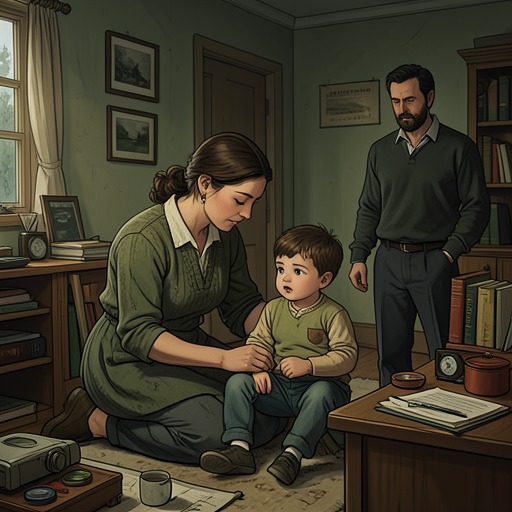
Celia Favreau and Drew Favreau’s marriage
All the Old KnivesCelia Favreau and Drew Favreau’s marriage is presented as both a deliberate turn toward family life and a break from Celia’s years in intelligence work. Their move to Carmel and the children they raise there embody the settled future she says she wanted; the return of a crisis involving Bill Compton, however, tests whether that new life can remain separate from her former commitments.
Courtship and the Move to Carmel
Celia and Drew dated for only four months before Drew proposed. He was an older man with few obvious charms, while Celia was widely admired and had spent her first three years in Vienna moving among young men before her year with Henry Pelham. Their friends struggled to understand the match. In Henry’s retrospective account, Sarah Western found Celia’s explanation—that she wanted to stop running around and sit still—unconvincing, and her friends eventually treated the marriage as a midlife decision. Celia was nearing forty, and after a life in the secret world, the prospect of rest seemed plausible to them. Their interpretation, however, was not the explanation Celia later gave herself.
Drew had spent half his working life in Vienna as a GM manager and retired at fifty-eight. Celia came with him to Carmel to make a life together. Henry, who had not spoken with her for five years, surveys that life from the outside: the town’s beach and restaurants, their house on Vista Street, and the family gathered there. His account includes Drew at sixty-three and weighing 180 pounds, four-year-old Evan, and one-and-a-half-year-old Ginny, whose long chestnut hair resembles her mother’s. These exacting details establish a household with routines and young children, but they also reveal the limits of Henry’s perspective: he has assembled a profile through research rather than through shared daily life with the couple.
Family as Celia’s Chosen Destination
When Celia explains the decision herself, she reverses the assumption that she married Drew simply to escape Vienna or secure a comfortable life. She says that coming to California to raise children had always been her destination. Her parents, before they died, taught her to be like them, and she describes family security as necessary to her sense of wholeness. The marriage is therefore not merely a retreat from her former life; in her account, it is a belated arrival at the future she had wanted.
That account gives a different meaning to her departure from the Agency. Celia describes her years there as an addiction: the thrill of secret knowledge kept her focused on the next high instead of on what would make her whole. She does not claim that the work had no appeal or that leaving it was effortless. Rather, she presents the marriage and the raising of children as a choice that counters the consuming attraction of the intelligence world. Her question is not why she moved to Carmel with Drew, but why she did not make that choice ten years earlier.
Henry’s narration complicates this explanation. He recalls Celia as a formidable conversationalist, able to improvise and make a story feel so authentic that even years later a listener might not know whether she had been taken in. The contrast matters: the woman who now speaks fluently about family and her past is also someone Henry believes can shape a persuasive account. The text gives her stated reasons directly, while keeping Henry’s uncertainty about how fully any account of Celia can be trusted in view.
A Domestic Life Under Pressure
Henry’s research sketches the work and routines that fill Celia’s new life. For six months after the move, she maintained a Facebook page featuring the beach, quaint restaurants, and upscale parties; the images stirred jealousy among her former Vienna circle, and her fate became a subject of embassy discussion. She then shut the page down. Friends noticed that her email replies grew delayed, often beginning with an apology that she had been busy. Sarah complained about the distance between the work of defending the free world and Celia’s failure to answer an ordinary check-in.
Celia’s busyness was not simply a pose. She became staff photographer for the Carmel Pine Cone, volunteered at the Sunset Center, and, by the time she was pregnant with her second child, had taken a part-time job at the Stevenson School. Henry interprets these choices as characteristic of Celia’s ability to lay groundwork for her own future or her child’s. She also met with therapist Dr. Leon Sachs for two hours a week, though Henry could not obtain the therapist’s notes. These details show a life built through practical commitments and care for the children, while the inaccessible records mark what Henry cannot know about her inner life.
The Past Returns to the Marriage
Celia says she expected California to offer relaxation, some luxury, intellectual stimulation, and a safe place to raise her children. Most pressingly, she wanted a complete escape from the Agency. That intention was interrupted about two weeks after she arrived, when Karl Stein contacted her about Bill Compton. He accused Bill of selling secrets to Islamist groups and asked Celia to fly to Vienna, draw him out, and entrap him. The proposal invoked the Flughafen and the Austrians’ need for answers, making Celia’s new home the starting point of a demand to re-enter the old world.
Celia says she refused. She told Karl that Bill had not sold them out to the Islamists and that, although he might have shared information with allies, he would not cross that line. She insists that her judgment rests on evidence and what she knows, not a stranger’s speculation, and that she will not turn either her life or Bill’s upside down on that basis. This refusal makes her bond with Bill another force complicating the clean break she sought through marriage. The episode does not show Drew’s response or establish how the dispute affected their relationship privately. It does show the pressure brought to the life Celia and Drew had made: the family future she chose is real, but it cannot prevent old loyalties and professional demands from reaching her in Carmel.